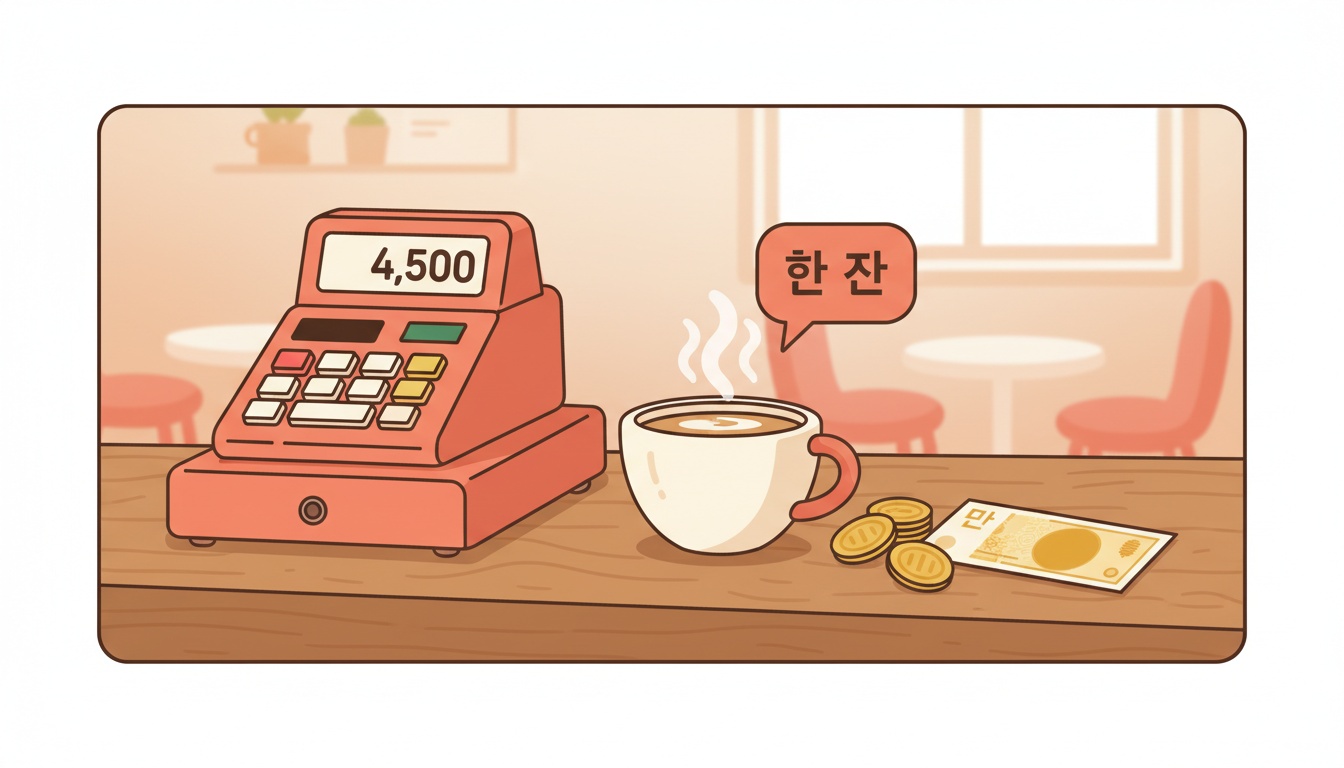
You're at a café in Seoul. A latte costs 4,500원. You know the word for "one," but which one? 하나 (hana) or 일 (il)? Korean has two completely separate number systems, native Korean and Sino-Korean, and the wrong choice in the wrong place sounds as off as saying "I'd like purchase seventeen of coffee."
The good news: you almost never have to guess. The situation picks the system for you. This post walks through the five scenarios that cover 90% of daily number use, with the exact phrases you need for each one.
Counting things: native Korean + a counter word
커피 한 잔 주세요 (keopi han jan juseyo) means "One coffee, please."
Every time you count a physical thing or a living being in Korean, you use a native Korean number paired with a counter word. The counter word is specific to the type of thing: 잔 (jan) for cups, 개 (gae) for general objects, 명 (myeong) for people, 마리 (mari) for animals. Think of them like saying "two cups of coffee" or "three head of cattle," except Korean does this with almost everything.
Here's where beginners trip: the numbers 1 through 4 change shape when they appear before a counter.
| Number | Standalone | Before a counter | |--------|-----------|-----------------| | 1 | 하나 (hana) | 한 (han) | | 2 | 둘 (dul) | 두 (du) | | 3 | 셋 (set) | 세 (se) | | 4 | 넷 (net) | 네 (ne) |
Numbers 5 through 10 stay the same: 다섯, 여섯, 일곱, 여덟, 아홉, 열.
So "three apples" is 사과 세 개 (sagwa se gae), not 사과 셋 개. And "two beers" is 맥주 두 병 (maekju du byeong), not 맥주 둘 병. Get these four shape-changes down and you've handled the biggest surprise in the native system.
A few phrases worth memorizing whole:
- 치킨 두 마리 주세요 (chikin du mari juseyo) — Two chickens, please
- 사람 다섯 명이에요 (saram daseot myeongiyeyo) — There are five people
- 책 한 권 주세요 (chaek han gwon juseyo) — One book, please
Telling time: both systems in one phrase
세 시 십오 분 (se si sibo bun) means "3:15."
This is the one that makes beginners stare. Hours use native Korean numbers. Minutes use Sino-Korean numbers. Same clock, two systems.
So 3:15 breaks down like this: 세 (native 3) + 시 (hour) + 십오 (Sino 15) + 분 (minute). Seven o'clock is 일곱 시 (ilgop si). Thirty minutes is 삼십 분 (samsip bun). Put them together for 7:30: 일곱 시 삼십 분.
There's no deep reason this is how it works. The pattern is consistent, though, and after you've said a few times out loud, the split starts to feel automatic. Practice with a clock: pick a random time, say it in Korean, check yourself. Ten repetitions and the strangeness fades.
Noon is 열두 시 (yeoldu si), native Korean 12. For AM and PM, Korean puts 오전 (ojeon, morning) or 오후 (ohu, afternoon) before the time: 오후 세 시 means 3 PM. Talk to Me in Korean's Level 1 Lesson 15 covers this with audio if you want to hear it spoken.
Money and prices: Sino-Korean, always
삼만 오천 원이에요 (samman ocheon woniyeyo) means "It's 35,000 won."
All prices in Korean use Sino-Korean numbers plus 원 (won). No exceptions. This part is straightforward until you hit the 만 (man) problem.
English groups large numbers by thousands: 10,000 is "ten thousand," 100,000 is "a hundred thousand." Korean groups by 만, which equals 10,000. That's the whole unit. So 30,000원 isn't "thirty thousand won." It's 삼만 원 (samman won), literally "three 만 won." And 150,000원 is 십오만 원 (siboman won): "fifteen 만 won."
This is the single hardest adjustment for English speakers dealing with Korean prices, because your brain wants to count in thousands and the Korean system simply doesn't. Here's how to retrain your instinct: when you see a Korean price, mentally chop off four zeros to find the 만 count. 50,000 = 5만 = 오만. 230,000 = 23만 = 이십삼만. Practice with real prices on Naver Shopping and you'll build the reflex faster than any flashcard app.
A taxi meter showing 15,000원: that's 만 오천 원 (man ocheon won), "one 만, five thousand won." Not "fifteen thousand."
Your age: it depends who's asking
스물다섯 살 (seumul-daseot sal) means "25 years old" to a friend. 이십오 세 (isibo se) means "25 years old" on an official form.
Casual Korean uses native numbers + 살 (sal) for age. Formal or official Korean uses Sino-Korean numbers + 세 (se). The split maps neatly onto the speech level system: if you'd use -요 or 반말 with someone, 살 is fine. If you're filling out paperwork or talking to a government clerk, use 세.
One more thing: Korea switched to 만나이 (mannai), international-style age counting, for legal purposes in 2023. Before that, everyone was one or two years "older" in Korean age. You might still hear older relatives use the traditional count in conversation, but official documents now use the international system with Sino-Korean numbers.
For beginners: just learn 살 with native numbers first. You'll use it ten times more often than 세.
Try it in Conversa
Practice with AI characters who adapt to your level and give real-time feedback.
Try Conversa FreeDates, floors, and everything else: Sino-Korean
삼 월 십오 일 (sam wol sibo il) means "March 15th."
Anything that's part of an abstract sequence uses Sino-Korean. March is 삼 월 (sam wol, "third month"). The 15th is 십오 일 (sibo il). The year 2026 is 이천이십육 년 (icheonisimnyuk nyeon). The third floor is 삼 층 (sam cheung). Bus number 1 is 일 번 (il beon).
The pattern: if you're identifying a position in a numbered sequence rather than counting physical things, reach for Sino-Korean.
The cheat sheet
| Scenario | System | Example | |----------|--------|---------| | Counting objects | Native Korean + counter | 사과 세 개 (3 apples) | | Counting people | Native Korean + 명 | 두 명 (2 people) | | Counting animals | Native Korean + 마리 | 고양이 한 마리 (1 cat) | | Cups / glasses | Native Korean + 잔 | 커피 한 잔 (1 coffee) | | Hours | Native Korean + 시 | 세 시 (3 o'clock) | | Minutes | Sino-Korean + 분 | 십오 분 (15 minutes) | | Money | Sino-Korean + 원 | 삼만 원 (30,000₩) | | Age (casual) | Native Korean + 살 | 스물다섯 살 (25) | | Age (formal) | Sino-Korean + 세 | 이십오 세 (25) | | Dates | Sino-Korean + 월/일 | 삼 월 십오 일 (Mar 15) | | Floors | Sino-Korean + 층 | 삼 층 (3rd floor) | | Phone / bus numbers | Sino-Korean + 번 | 일 번 (No. 1) |
Three mistakes every beginner makes
Using Sino-Korean with counter words. Saying 일 개 instead of 한 개. Sino-Korean numbers almost never appear next to counter words for physical things. If there's a counter, switch to native Korean.
Forgetting the 1–4 shape change. Saying 하나 잔 instead of 한 잔. The standalone forms (하나, 둘, 셋, 넷) are for when the number stands alone. As soon as a counter follows, they shorten. This feels arbitrary until it becomes muscle memory, which takes about two weeks of daily practice.
Thinking in thousands instead of 만. Mentally translating 50,000원 as "fifty thousand" and then trying to build that in Sino-Korean. The conversion stalls because Korean doesn't think in thousands for large numbers. Retrain: 50,000 = 5만 = 오만. Skip the thousands entirely.
If you're studying Mandarin alongside Korean, you might notice a familiar pattern. Mandarin uses 万 (wàn) the same way Korean uses 만. The measure word system is a close cousin of Korean counters, too. The two languages borrowed from the same Chinese number framework centuries ago, and the family resemblance still shows.
The 만 system will take real practice, and the 1–4 shape changes need a couple of weeks to stick. But the rest is pattern-matching: counters get native Korean, sequences get Sino-Korean, time splits the difference. Learn the five scenarios above, practice each one with real phrases, and the two systems stop feeling random within a few weeks.