A learner writes 昨天我去了学校 (zuótiān wǒ qù le xuéxiào — "yesterday I went to school") and the native speaker nods. Great. Next day, the same learner writes 他以前常常学了中文 (tā yǐqián chángcháng xué le Zhōngwén — "he used to often study Chinese") and the native speaker shakes their head. Drop the 了. Why? Both are in the past. Both describe completed-ish events. Both feel like "past tense" to an English brain.
Here is the trick the textbook shortcut hides: 我吃饭了 and 我吃了饭 use the exact same three characters in almost the same order, and they do not mean the same thing. One is "I've eaten (and I'm done now)." The other is "I ate (and…)". If that confuses you, you are not dumb. You were taught that 了 means past tense, and that explanation falls apart the moment you meet a real sentence.
By the end of this post you will know: what 了 actually marks, the two separate 了s hiding inside one character, the three contexts where you must leave 了 out, and the double-了 trick that natives use constantly.
Mandarin Has No Tense. That's Not a Typo.
Write "I will eat," "I am eating," and "I ate" in Mandarin and the verb itself — 吃 — never changes shape. English makes you mark past, present, and future on the verb. Mandarin does not. Chinese does not have grammatical markers of tense. Verbs do not conjugate. There is no Mandarin equivalent of -ed or will. What Chinese does have is aspect — markers that tell you how an action unfolds in time, not when it happens.
Time words carry the "when." 昨天 (yesterday), 明天 (tomorrow), 去年 (last year) — those place you on the timeline. 了 tells you something different: that the action is bounded, completed, or that the situation has changed. Completed in the past, completed right now, completed in the future — all fair game.
That last one is the proof. Look at this sentence from East Asia Student's four-kinds-of-了 breakdown:
明天我吃了午饭以后就跟朋友出去玩儿。 Míngtiān wǒ chī le wǔfàn yǐhòu jiù gēn péngyǒu chūqù wánr. "Tomorrow after I eat lunch I'm going out with friends."
That 了 is sitting inside a sentence about tomorrow. If 了 were past tense, this sentence would be nonsense. It isn't. The 了 is marking that the action of eating lunch is bounded — it reaches completion — before the next clause happens. Past tense never entered the chat.
There Are Actually Two 了s, and They Live in Different Places
了₁ sits right after the verb. 了₂ sits at the end of the sentence. Linguists who study Mandarin seriously (Mei, Li & Thompson, and others cited on Language Log) treat them as two different morphemes that happen to share one character and one pronunciation. Once you see them as two words that happen to share a spelling, the whole system clicks.
Verb 了 — the completion marker
Position: right after the verb. Job: marks that the action is bounded or completed in whatever time frame you're talking about.
Examples from the Chinese Grammar Wiki's perfective le page:
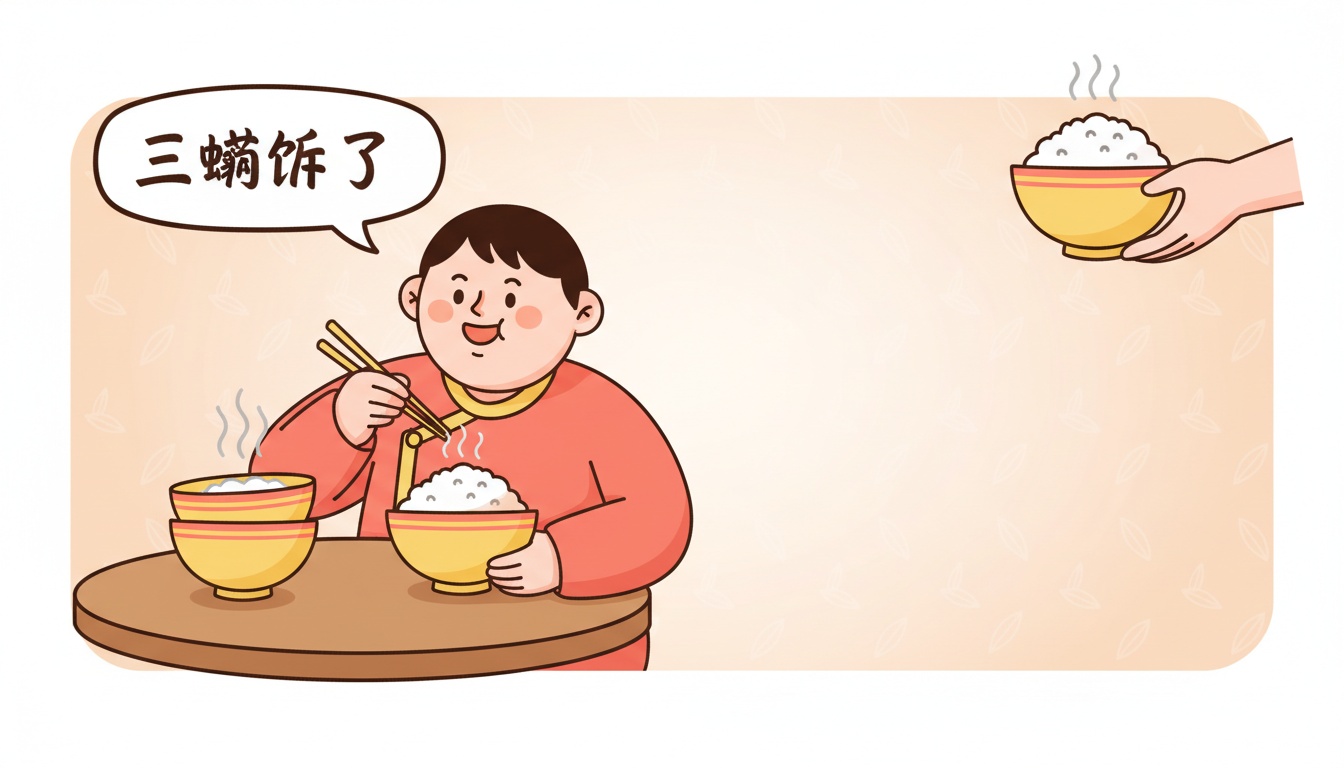
- 我吃了三碗饭。 Wǒ chī le sān wǎn fàn. — "I ate three bowls of rice."
- 他买了一本书。 Tā mǎi le yī běn shū. — "He bought a book."
One rule that surprises beginners: verb-了 with a bare, unqualified object feels incomplete on its own. 我吃了饭 hangs in the air like an unfinished sentence — the listener waits for what happened next. Give it a quantifier (三碗 "three bowls") or a follow-up clause (…然后去上班 "…then went to work") and it stands up.
Sentence-final 了 — the change-of-state marker
Position: end of the sentence. Job: says the situation is now different from before. The Chinese Grammar Wiki's change-of-state page calls it exactly that.
- 天气冷了。 Tiānqì lěng le. — "The weather's gotten cold." (wasn't before; now it is)
- 我不抽烟了。 Wǒ bù chōuyān le. — "I don't smoke anymore." (used to; no longer)
- 她是医生了。 Tā shì yīshēng le. — "She's a doctor now." (wasn't; now is)
- 他来了。 Tā lái le. — "He's here."
Read that last one out loud. "He's here." Not "he came" in the past-tense sense, not "he is coming" in the progressive sense — "he's here, which wasn't true a second ago, and now it is." That's the whole job of sentence-final 了 in one syllable.
Minimal Pair: Same Words, Different 了, Different Meaning
Here are three sentences using the same three characters, arranged in the three ways 了 lets you arrange them:
我吃饭了。 Wǒ chī fàn le. — "I've eaten / I'm done eating." Sentence-了. Change of state: I wasn't done before, I am now. The classic response to "have you had dinner?"
我吃了饭。 Wǒ chī le fàn. — "I ate…" Verb-了 with a bare object. Incomplete on its own — the listener is waiting. "…and then went out," maybe. Almost never stands alone in real speech.
我吃了饭了。 Wǒ chī le fàn le. — "I've already eaten." Double 了. Completed action + relevant to the current situation. This is the answer a friend gives when you ask if they want to grab food and they're politely declining. The first 了 says "the eating is done," the second 了 says "and that's where I'm at now, so thanks but no."
Same three characters. Three different sentences. If anyone ever told you 了 is past tense, this is why that cost you so many broken sentences.
Try it in Conversa
Practice with AI characters who adapt to your level and give real-time feedback.
Try Conversa FreeWhere 了 Is Forbidden — Three Traps
Start with this error: ❌ 他每天晚上加了班。 You almost certainly want to write that sentence at some point — it feels right. It isn't. Knowing when to leave 了 out is at least as important as knowing when to put it in. The DigMandarin mistake list is where a lot of these errors get caught in classroom settings.
Trap 1: Habitual or repeated past
If the action is a habit — something that used to happen regularly — you do not use 了, even though every instinct screams past tense.
Wrong: ❌ 他以前常常在早上学了中文。 Right: ✅ 他以前常常在早上学中文。 Tā yǐqián chángcháng zài zǎoshang xué Zhōngwén. "He used to often study Chinese in the morning."
Same logic for our opening example:
Wrong: ❌ 他每天晚上加了班。 Right: ✅ 他每天晚上加班。 Tā měitiān wǎnshang jiābān. "He works late every night."
The habit isn't a single bounded event. There's no completion moment to mark. 常常 and 每天 are doing all the work of placing the action in time.
Trap 2: Stative verbs with verb-了
You cannot finish liking someone. You cannot finish being a student. You cannot finish knowing something. Stative verbs — 是 (to be), 有 (to have), 喜欢 (to like), 知道 (to know), 爱 (to love) — describe ongoing states, not bounded actions. So you cannot slap verb-了 onto them to mean "in the past":
Wrong: ❌ 我喜欢了她 is not how you say "I liked her."
Here is the twist that confuses everyone: sentence-final 了 still works with stative verbs, because it marks a change to the whole situation, not the completion of the verb.
- 她是医生了。 — "She's a doctor now." (perfectly fine — change of state)
- 你不喜欢猫了? Nǐ bù xǐhuān māo le? — "You don't like cats anymore?"
- 我有钱了。 Wǒ yǒu qián le. — "I have money now" (whereas I didn't before).
Verb-了: no. Sentence-了: yes. Same verb, different 了, different job.
Trap 3: Negation
The moment you put 没 (méi) in front of the verb, the 了 goes away.
Right: ✅ 我没吃饭。 Wǒ méi chī fàn. — "I didn't eat." Wrong: ❌ 我没吃了饭。
The logic is almost too clean: an action that never completed can't carry a completion marker. If you didn't do it, there's no finished event for 了 to point at.
The Double 了 Trick Natives Use All the Time
我吃了三碗饭了。 That is the sentence a friend uses to tell you they're three bowls deep and still going. The second 了 is the whole trick. The Chinese Grammar Wiki calls the pattern "expressing ongoing duration with double 'le'". The structure is:
Verb + 了 + (quantity or duration) + 了
The first 了 says "the action has been happening and has reached this much." The second 了 says "and that's the current state — I haven't stopped." It's the difference between reporting a finished total and reporting a running total.
- 我吃了三碗饭了。 — "I've eaten three bowls (so far)." The second 了 adds: and I'm still at the table.
- 他已经睡了十个小时觉了。 — "He's been asleep for ten hours." And he's still asleep. (Chinese Boost uses a similar construction.)
- 我学中文学了两年了。 — "I've been studying Chinese for two years." And I'm still studying.
Contrast those with the single-了 versions:
- 我吃了三碗饭。 — "I ate three bowls." (finished, walked away)
- 我学了两年中文。 — "I studied Chinese for two years." (and then I stopped)
The second 了 is a little hook that keeps the action alive in the present. Once you hear it a few times, you'll start reaching for it when you want to say "and I'm not done yet."
A Quick Self-Correction Drill
Before you scroll past, translate "I'm not a student anymore" in your head and check it against the answer below. Then try the other two.
- "I'm not a student anymore." Stative verb (是) → forget verb-了, use sentence-了: 我不是学生了。
- "I've been in Beijing for three days (and I'm still here)." Continuing duration → double 了: 我在北京住了三天了。
- "I used to drink coffee every morning." Habitual past → no 了: 我以前每天早上喝咖啡。
If you want to stop second-guessing every sentence, the only thing that works is hearing the difference enough times to feel it. An AI conversation partner like Conversa is one cheap way to rack up that exposure without pinning a native speaker down for twenty minutes on the word 了. Textbooks can describe 了. Only practice makes 我吃饭了 and 我吃了饭 stop looking like the same sentence.
The One Question to Ask
Stop translating 了 as "past tense" in your head. Start translating verb-了 as "the action is complete" and sentence-了 as "the situation is now different." When you write a sentence and aren't sure which one you want, ask: am I marking that something finished, or that something changed? The answer tells you where the 了 goes — or that you don't need one at all.