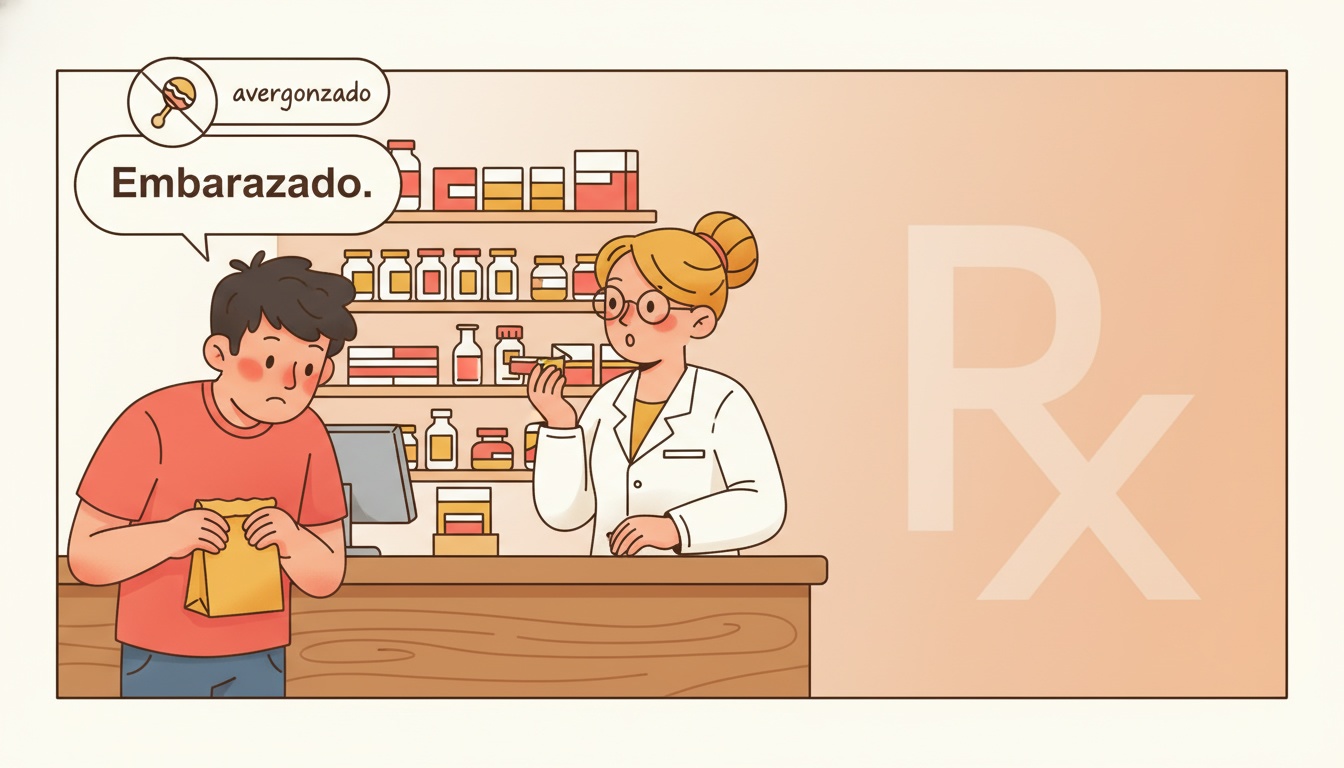
The first time I said "estoy embarazada" to a Spanish pharmacist, I meant "I'm embarrassed." The pharmacist raised both eyebrows and asked when I was due. I was a twenty-year-old man. The word I wanted was avergonzado, and the reason I didn't reach for it is the reason false cognates exist at all: Spanish and English share enough Latin that most of the time, the English-sounding word is right. That's the trap. The 10% of the time it's wrong, it's very wrong, and it's almost never wrong at random. It goes sideways in specific places: pharmacies, offices, dinner tables.
Here are the words that ambush you grouped by where you'll actually meet them, with the line you reached for, the line you needed, and the fix.
At the pharmacy: the ones that send the wrong medical signal
— ¿Cómo se siente? — Estoy embarazada.
You meant "embarrassed." You just told the pharmacist you're pregnant. embarazada means pregnant, full stop. There is no dialect in which a grown adult says this for "embarrassed." The word you wanted is avergonzado/a.
A few others will get you in the same aisle:
- constipado is not constipated. It means you have a head cold. The other thing is estreñido/a. Telling a Spanish friend "estoy constipado" will get you sympathy about your sinuses, which is less mortifying than the alternative but still not the message.
- preservativo is not a preservative. It's a condom. Ask if the jam has too many preservativos and you will get a very strange look. The English "preservative" is conservante.
- intoxicado is not intoxicated in the "I had too much wine" sense. It means poisoned: usually food poisoning, sometimes general. If you tell a doctor "anoche estaba muy intoxicado" you're reporting a food-safety incident. Drunk is borracho or ebrio.
I still catch myself hesitating at pharmacy counters before I say anything at all. The embarazada story is worth the fifteen seconds of rehearsal.
At work: the ones that make you sound vague or slightly off
— Realicé que el informe tenía un error.
Your Spanish-speaking colleague hears: "I carried out that the report had an error." Which means nothing. realizar means to carry out, to execute, to accomplish. It's the verb for realizing a plan, in the older English sense. The word you wanted for "I realized" is darse cuenta de. "Me di cuenta de que el informe tenía un error." That's the one.
Workplace false cognates cluster hard around words that end in -izar, -ducir, and -iso:
- introducir looks like "introduce" but means to insert, literally: insert a password, insert a coin. Introducing a person is presentar. "Te presento a María." Not "Te introduzco a María," which sounds like you're handing María to someone in a tube.
- compromiso looks like "compromise" and actually means commitment, engagement, or obligation. If you tell a negotiation partner "llegamos a un compromiso," you sound like you reached some kind of undefined commitment. The word for the meet-in-the-middle kind of compromise is acuerdo or punto medio.
- éxito looks like "exit" and means success. Pointing at an éxito sign and telling a coworker "it's over there" is not helpful directions. The exit is la salida.
- carpeta looks like "carpet" and means folder. Your boss asking you to put something en la carpeta does not want it on the rug.
The rough rule: in a professional setting, any Spanish word that sounds exactly like an English word and ends in -izar, -ducir, or -iso is worth a five-second check before you commit to it.
At dinner: the ones that confuse the meal
— Nos vemos a las cinco para tomar once.
In Chile, this is an invitation to afternoon tea. Bread, cheese, ham, coffee, around 5 p.m. The number eleven has nothing to do with it. According to SpanishDict and native Chilean speakers, once is a cultural false friend more than a vocabulary one: the word is numeric everywhere else, but in Chile you'll see it on café menus and on people's afternoon plans. If someone invites you to tomar once and you show up at 11, you're four to six hours early.
At the table, watch for these too:
- asistir is not to assist. It means to attend. "¿Cuántos van a asistir a la cena?" asks how many people are coming to dinner, not how many are helping. If you want to say "help me," it's ayudar: "¿me ayudas?"
- molestar is nothing like the English "molest." It just means to bother. A waiter asking "¿le molesta si me siento aquí?" is asking permission to sit. Native speakers use this constantly and it is entirely innocent. "No me molesta" means "I don't mind."
- librería is not a library. It's a bookstore. The library is biblioteca. If a Spanish friend says they spent Saturday at the librería, they went shopping, not studying.
One strange dinner I sat through in Santiago, the host kept apologizing that dinner wouldn't be served until nine because we'd just had once. I had heard "eleven" and assumed she meant 11 p.m., which sounded wildly late. She meant the afternoon tea I had sat through an hour earlier without realizing it had a name.
Meeting the family: the ones that derail small talk
— ¿Y tus parientes, viven cerca?
You answer about your mom and dad. Your Spanish-speaking host was asking about your relatives, all of them. pariente covers aunts, cousins, in-laws, grandparents, the whole tree. The specific word for "parents" is los padres. It's a small miss but it changes the whole arc of the conversation, because they're trying to figure out whether your wider family is nearby and you keep circling back to your mother.
Family small talk is also where the emotional-description words pile up, and several of them are traps:
- sensible doesn't mean sensible. It means sensitive. Telling your partner's mother that her son is muy sensible says he cries at commercials. Which, fine, but may not be what you meant. The word for "sensible" in the English "level-headed" sense is sensato/a or razonable.
- decepción is not deception. It means disappointment. "Fue una decepción" is "it was a letdown," not "it was a lie." English "deception" is engaño or fraude.
- bizarro is complicated on purpose. Traditionally in Spain it meant brave or gallant. Under English and Italian influence it has drifted toward weird in much of Latin America, and FundéuRAE now accepts both meanings depending on context. Which means if you call your partner's uncle bizarro, half the table will hear "valiant" and half will hear "freak." Just say raro or extraño when you mean weird.
Emotional-description words are where family conversations live. Slow down on anything that sounds exactly like an English adjective for a person's character. Those are the ambush words.
Try it in Conversa
Practice with AI characters who adapt to your level and give real-time feedback.
Try Conversa FreeOn the move: the ones that reroute your trip
— ¿Tiene ropa para mi maleta?
You're at the hotel desk. You meant rope, because you want to strap down an overstuffed suitcase. What you just asked is "do you have clothes for my suitcase," and the concierge is very confused. ropa means clothes. Rope is cuerda or soga.
On the road, false cognates multiply because you're tired and reaching for whatever sounds familiar. Four show up constantly:
- recordar is not to record. It means to remember. "¿Puedes recordar esto?" means "can you remember this?" It does not mean "can you film this?" To record audio or video is grabar. Your phone doesn't recuerda a video, it graba.
- atender is not to attend. It means to wait on or tend to. "Ya la están atendiendo" at a hotel front desk means "someone's already helping her." To attend an event is asistir a. Yes, this means asistir and atender flip their English-sounding meanings: asistir is for attending events, atender is for helping people.
- actualmente is not actually. It means currently. "Actualmente vivo en Lima" is "I currently live in Lima." The word for English "actually" is en realidad or de hecho.
- fábrica is not a fabric. It means factory. Fabric is tela. On a tour, if the guide says "a la derecha hay una fábrica de textiles," there's a textile factory over there, not a roll of cloth.
When you're traveling, cheat: before you enter a new situation, think about what you're actually trying to ask and pre-check the one or two words you're about to reach for.
How to train yourself out of Spanish false cognates
I once stood in an Oaxaca pharmacy at 9 p.m. with a memorized list of twenty false cognates in my head, and embarazada still came out of my mouth. The list sits in your head in a calm room while the actual word comes out of your mouth in a pharmacy at night. Memorizing a top-10 list doesn't work. What works is rehearsing the word inside the scene.
Three things I'd actually do:
Build scenes, not flashcards. Instead of embarazada = pregnant, write yourself the full line you would say, like "Perdón, estoy avergonzado" for the moment you apologize to a waiter for knocking over your water. Practice the line, not the pair. This is the same principle behind scene-based listening practice: context trains recall better than isolated pairs.
Treat exact-match cognates as suspect. Spanish words that sound partially like English, such as interesante, importante, necesario, are almost always fine. The ones that sound exactly like English are the traps: embarazada, constipado, sensible, realizar. The tighter the match, the more likely it's a fake.
Practice out loud where the stakes are zero. You can't rehearse these traps on a textbook page because they're context-dependent, and the context has to feel real. An AI conversation partner like Conversa lets you run the same scenario (the pharmacy, the office, the dinner table) over and over until the correct word is the one that shows up first. If you want early access, you can join the tester list. That's the whole game: making the right word the reflex.
The real lesson
The next time you walk into a Mexican pharmacy, the only word that matters is avergonzado. Not the list of twenty-odd false cognates you've been carrying around. Just that one, plus conservante if you're checking a label, plus estreñido if things have really gone wrong. False cognates are not a memory problem. They're a rehearsal problem. Pick the next country you'll be in. Pick the three scenes you'll actually be in there. Load the three swaps for those three scenes. That's the whole job.