At a bed-and-breakfast outside Annecy, I asked the host whether the homemade jam had any préservatifs. I meant preservatives. He raised his eyebrows, looked at the jam, looked at me, and answered very carefully that it did not. The word I wanted was conservateurs, and the reason I reached for préservatif is the reason faux amis exist at all: French and English share so much vocabulary that most of the time, the English-sounding word is right. That's the trap. The 10% of the time it's wrong, it's catastrophically wrong, and it almost never goes wrong at random. It goes wrong in specific places: cafés, offices, pharmacies, bookstores, dinner tables.
Here are the French false cognates that ambush English speakers, grouped by where you'll actually meet them, with the line you reached for, the line the French speaker heard, and the fix.
At the café: the ones that turn breakfast into a farce
— Est-ce qu'il y a des préservatifs dans la confiture ?
You meant preservatives. You just asked whether the jam contains condoms. Préservatif is masculine, singular, and it means one thing. There is no dialect of French in which a grown adult uses it for food additives. The word you wanted is conservateur, or the phrase agent de conservation.
A few others will ambush you in the same room:
- monnaie is not money. It's loose change, the coins you get back at the counter. Money in general is argent. Telling a café owner "je n'ai pas de monnaie" means "I don't have exact change," not "I'm broke."
- coin has nothing to do with coins. It means corner, spot, or local area. Le café du coin is the neighborhood café. A coin (currency) is une pièce. When a French friend offers to take you to un petit coin sympa, they mean a nice little spot.
- pain is bread. The English word "pain" shares no etymology with it. Je voudrais du pain is a breakfast request, not a complaint. The French word for pain is douleur.
Café faux amis are low-stakes. The worst that happens is the host smiles politely and you get your jam. They're the friendliest introduction to the pattern, because you'll hit at least two of them before you finish your first croissant.
At work: the ones that make you sound vague or slightly off
— Actuellement, je pense que le rapport a une erreur.
Your French colleague hears "Currently, I think the report has an error," which sounds like an ongoing philosophical stance rather than a moment of realization. Actuellement means currently, at the moment, at present. It's the calendar sense of "now," not the logical sense of "in fact." The word you wanted is en fait or en réalité. "En fait, je pense que le rapport a une erreur." That's the one.
Workplace faux amis cluster hard around adverbs and verbs that describe when something happened or what you did:
- éventuellement looks like "eventually" and means possibly, perhaps. Telling a negotiation partner "on pourrait éventuellement signer demain" means "we could possibly sign tomorrow," not "we'll sign eventually." The word for English "eventually" (in the end) is finalement.
- assister à looks like "to assist" and means to attend. "J'ai assisté à la réunion" = "I attended the meeting." To help someone is aider.
- attendre looks like "to attend" and means to wait. Yes, assister à and attendre flip their English-sounding meanings, which is the double trap that catches people twice in the same conversation.
- prétendre looks like "to pretend" and means to claim, to assert. "Il prétend être médecin" is "he claims to be a doctor," not "he's pretending to be one." To pretend is faire semblant.
The office cluster is the one that makes a French colleague re-read your email twice. Nothing fatal happens. You just sound like someone whose timeline of events is slightly wrong.
At the pharmacy: the ones that send the wrong medical signal
— Bonjour, je voudrais des pilules pour le mal de tête.
You meant aspirin. The pharmacist heard a request for pills, which in French is technically correct but socially strange, because French pharmacy culture asks for medications by form or brand. What you want is un comprimé (a tablet) or just the brand: "Doliprane, s'il vous plaît."
Three more trip wires:
- blesser is not to bless. It means to wound, to injure. "Je me suis blessé" means you have hurt yourself. To bless is bénir.
- sensible does not mean "sensible" in the English "level-headed" sense. It means sensitive. "J'ai la peau sensible" is "I have sensitive skin," not "I have reasonable skin." Sensible (level-headed) is raisonnable or sensé.
- rester is not to rest. It means to stay, to remain. "Je vais rester au lit" means "I'm going to stay in bed." The pharmacist asking "vous pouvez rester assis ?" wants to know if you can stay seated, not whether you can nap there. To rest is se reposer.
I still rehearse the sentence in my head before I walk into a French pharmacy. Fifteen seconds of prep has saved me from several medical charades.
On the move: the ones that reroute your trip
— Je cherche une librairie avec wifi.
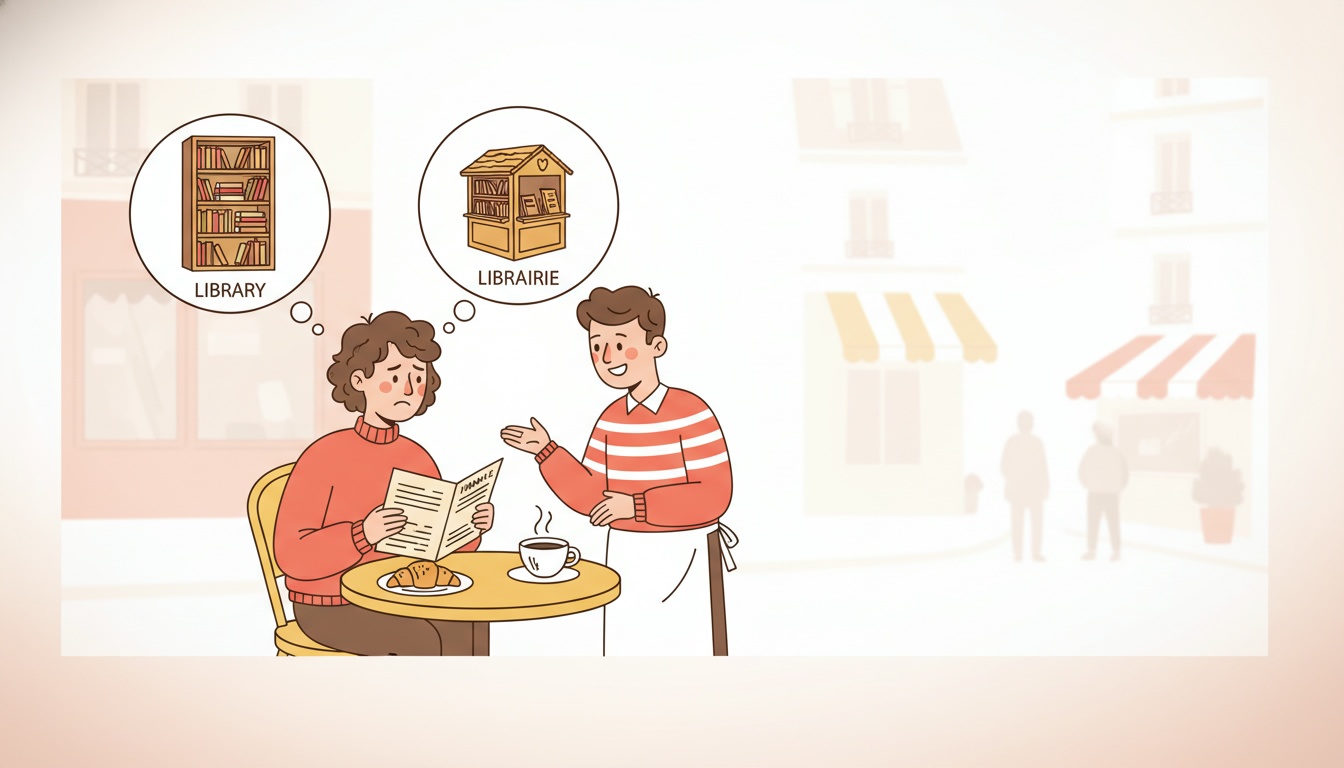
You meant library. The French host heard "bookstore with wifi," which is a fine thing to want but not what you needed if you were trying to write a dissertation. Librairie is a bookstore. A public library is une bibliothèque.
Travel and navigation faux amis show up constantly because you're tired and reaching for whatever sounds familiar:
- location is not a location. It means rental. A sign that says "location de voitures" is a car rental place, not a photo spot. The English "location" in the sense of "a place" is un endroit or un lieu.
- magasin looks like "magazine" and means shop or store. The publication you read on a plane is un magazine, with an -e. A French friend saying "je vais au magasin" is running errands, not going to the newsstand.
- passer un examen does not mean to pass an exam. It means to take one, with no implication of the result. "J'ai passé mon bac" means "I sat my final exams," and the listener has no idea whether you passed. To pass (successfully) is réussir un examen. Flip this one and you'll tell relatives your kid passed their exams when in fact the results aren't even in yet.
When you're traveling, cheat: before you walk into a situation, pre-check the one or two words you're about to reach for. It's the five-second audit that prevents the twenty-minute apology.
At the dinner table: the ones that derail family small talk
— Quelle déception, ce dîner.
This one is a flipped trap. You probably meant "what a disappointment" and that is, technically, exactly what came out of your mouth. But in your head you were reaching for the English "deception," which would have been a wild accusation at someone's house. Déception in French means disappointment. English "deception" is tromperie or duperie. This is one of the rare cases where the faux ami protects you from yourself.
A few more that reshape family small talk:
- journée vs jour is a false friend with itself. Both mean "day." Jour is the 24-hour calendar unit you count with: trois jours, three days. Journée is the daytime filled with activity, the one you feel: une longue journée, a long day. Saying "bonne jour" as you leave sounds broken. It's "bonne journée."
- entrée is not the main course. In France, l'entrée is the starter, the small first course. The main course is le plat or le plat principal. If you ask the host what's for entrée expecting the roast, you'll be confused for forty-five minutes.
- excité(e) is the one I wish someone had warned me about at fifteen. In adult conversation it reads first as sexually aroused, not neutrally "excited." Telling your partner's mother you're très excité about the weekend ahead is not the impression you want. For neutral eager-anticipation, use enthousiaste or the phrase j'ai hâte ("I can't wait"). Context can rescue it for children and animals, but at a dinner table with adults, don't reach for it.
Family conversations are where character adjectives pile up, and several of them are traps. Slow down on anything that sounds exactly like an English word for a person's mood.
Try it in Conversa
Practice with AI characters who adapt to your level and give real-time feedback.
Try Conversa FreeHow to train yourself out of French false cognates
I once stood in a Lyon pharmacy at 9 p.m. with a memorized list of twenty faux amis in my head, and préservatif still almost came out of my mouth when I was trying to ask about allergy medication additives. The list sits in your head in a calm room. The actual word comes out of your mouth in a pharmacy at night. Memorizing a top-20 list doesn't fix that. What fixes it is rehearsing the word inside the scene.
Three things I'd actually do:
Build scenes, not flashcards. Instead of writing préservatif ≠ preservative, write yourself the full line you'd say: "Est-ce qu'il y a des conservateurs dans la confiture ?" Practice the whole line, not the vocabulary pair. This is the same principle behind scene-based listening practice: context trains recall better than isolated pairs.
Treat exact-match cognates as suspect. French words that sound partially like English, such as intéressant, important, nécessaire, possible, are almost always fine. The ones that sound exactly like English are the traps: actuellement, éventuellement, sensible, location, librairie. The tighter the match, the more likely it's a fake. (If you're also studying Spanish, the sibling problem exists there too — the canonical Spanish false cognates by scenario hit the same nerve with different vocabulary.)
Rehearse out loud where the stakes are zero. You can't train these reflexes on a textbook page because the words are context-dependent, and the context has to feel real. An AI conversation partner like Conversa lets you run the same scene (the breakfast buffet, the pharmacy counter, the job interview) over and over until the correct word is the one that shows up first. If you want early access, you can join the tester list. The whole game is making the right word the reflex.
The real lesson
The next time you walk into a French breakfast buffet, the only word that matters is conservateur. Not the list of thirty-some faux amis you've been carrying around. Just that one, plus comprimé if you're at a pharmacy counter, plus bibliothèque if you're looking for a quiet place to write. Faux amis are not a memory problem. They're a rehearsal problem. Pick the next French scene you'll actually be in. Load the three swaps for that scene. That's the whole job.