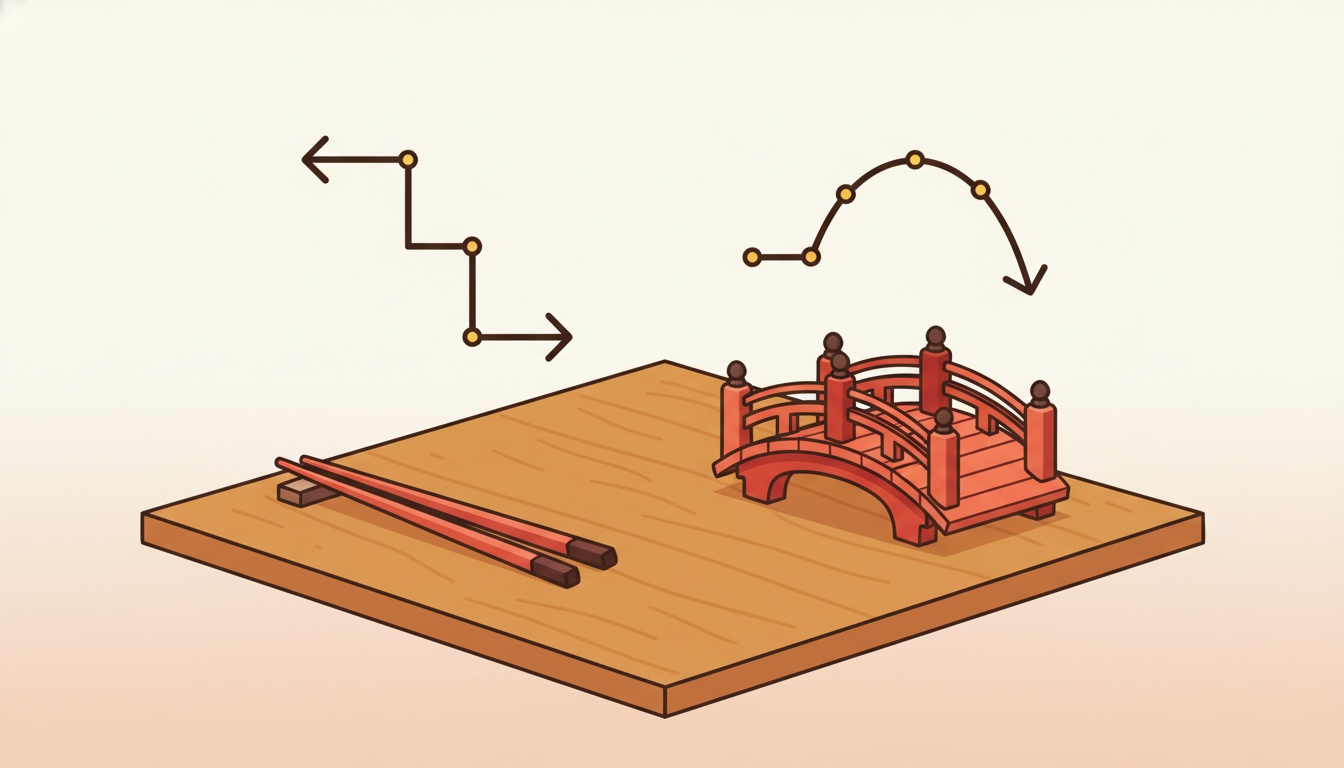
箸 (hashi) is chopsticks. 橋 (hashi) is a bridge. 端 (hashi) is the edge of something. Three kanji, three meanings, one sound. Native speakers tell them apart instantly, and not from context. They do it from pitch.
Somewhere in your first Japanese lesson you were told the good news: Japanese isn't tonal like Mandarin. You took that to mean pronunciation would be fine if you got the vowels and consonants roughly right. You've been speaking flat ever since, and the reason your Japanese still sounds robotic after a year of study is not your grammar. It's pitch accent: the one downstep per word that Japanese actually does have, and the rules that make it learnable.
"No tones" is the wrong story
Say 雨 the wrong way and a native hears 飴. Say 雨 (A-me, high-low) and it's rain. Say 飴 (a-ME, low-high but drops on a following particle) and it's candy. The two words differ by one high-to-low flip, nothing else. English has nothing like this, so English-speaking learners keep substituting stress for pitch and wondering why natives double-check what they just said.
Japanese is a pitch-accent language, which is a category separate from tone languages like Mandarin (where every syllable carries its own contour) and stress-accent languages like English (where stressed syllables get loudness, length, and pitch stacked together). In Japanese, the only thing that matters is whether the pitch drops and, if so, where.
Linguists still argue about whether "pitch accent" deserves to be its own typological bucket. Larry Hyman's 2009 paper makes a well-known case that it's a restricted tone system. That debate is useful for academics. For you, the practical reality is simpler: every word has at most one downstep, the downstep is fixed for that word, and getting it wrong makes natives reparse you. (For a parallel "the thing you were told isn't quite right" move on Japanese grammar, see the は vs が breakdown.)
Back to the three hashi. Using the standard high-low notation:
| Word | Meaning | Pitch | With が attached | |---|---|---|---| | 箸 | chopsticks | HAshi (HL) | HAshi-ga (HLL) | | 橋 | bridge | haSHI (LH) | haSHI-ga (LHL), drops on が | | 端 | edge | haSHI (LH) | haSHI-ga (LHH), stays high on が |
Bridge and edge sound identical in isolation. The particle gives them away. This is the demonstration that makes pitch accent feel real instead of theoretical. The TUFS pronunciation module walks through the same pair with audio if you want to hear it.
The four pitch accent patterns
Every Japanese word fits one of four patterns in the Tokyo dialect, which is the one used by textbooks, NHK news, and JLPT tests.
- 頭高 (atamadaka), head-high. High on mora 1, drops immediately. 雨 A-me (rain).
- 平板 (heiban), flat-board. Low, then high, stays high through the whole word and any particle. さかな sa-KA-NA (fish).
- 中高 (nakadaka), middle-high. Rises, then drops somewhere in the middle. おととい o-TO-To-i (day before yesterday).
- 尾高 (odaka), tail-high. Stays high through the word, drops on the first attached particle. 男 o-TO-KO ga↓ (man).
The cruel detail: odaka and heiban are identical in isolation. The only way to hear the difference is to attach a particle and listen for the drop. When someone says "花 (hana, flower) ga…" and the が lands low, it's odaka. When they say "鼻 (hana, nose) ga…" and the が stays high, it's heiban.
The one rule that gets you to "not flat" by lunch
Default to heiban. When you don't know a word's accent, pronounce it flat: low on mora 1, high from mora 2 onward, and keep any particle high too.
You'll be right roughly half the time on common nouns, according to the corpus analysis summarized in Tatsumoto's pitch accent primer. For the thousand most common verbs, the heiban share is higher, closer to two-thirds. That means a blind heiban guess beats a flat monotone every single time, because at least half of your guesses actually land on the right contour instead of collapsing every word into the same one.
The false precision you'll see on other blogs ("70% of nouns are heiban!") doesn't hold up in the sources. The honest figure is "roughly half," and that's still enough to make the rule useful.
Three inheritance rules for verbs, adjectives, and katakana
Verbs come in two classes
A Japanese verb is either heiban or accented, usually on the mora right before its final う/る/つ. Conjugated forms mostly inherit the class. 話す (hanasu, speak) is heiban, so 話します (hanashimasu) and 話して (hanashite) stay flat-then-high all the way through. 書く (ka↓ku, write) is accented, so 書きます becomes ka↓kimasu. The polite -masu form adds its own fixed accent that overrides the verb's pattern, but the two-class split handles most of what you'll say out loud.
-i adjectives drop right before the い
Most accented -i adjectives carry their downstep on the mora immediately before い. 高い is ta-KA↓-i, 速い is ha-YA↓-i. But not every -i adjective is accented. 難しい (muzukashii, difficult) is heiban: flat all the way through. Don't assume every adjective drops. Check unfamiliar ones.
Katakana loanwords follow a third-from-end rule
For loanwords of four or more moras, the downstep lands on the third mora from the end. This pattern was identified in Kubozono (2006) in Lingua and is now the standard citation for loanword pitch. コーヒー (four moras: コ・ー・ヒ・ー) is ko-O↓-hi-i. ドキュメント (five moras) is do-kyu-ME↓-n-to. Shorter loanwords like テレビ (TE↓-re-bi, TV) often go atamadaka instead. It's a tendency, not a law, but it covers most of what shows up in a daily conversation.
Look one word up in OJAD in 60 seconds
The Online Japanese Accent Dictionary is the tool you actually want. It's free, maintained by the University of Tokyo, and covers roughly 9,000 nouns and more than 42,000 conjugated verb and adjective forms.
Here's the whole workflow:
- Go to the site. Pick a word you use every day, something like 学校 (gakkou, school), or a verb you keep tripping on.
- Type the dictionary form in the search box. For verbs, you'll get a grid showing every conjugation (dictionary, polite, past, -te, negative) with the pitch contour drawn above it.
- Read the contour. Red blocks mean high pitch, blue mean low, and the cliff between them is the downstep. Heiban words have no cliff at all.
- Hit play. The audio is synthesized but cleanly pitched.
If you want sentence-level practice, OJAD also runs a tool called Suzuki-kun that accepts a full sentence and draws the pitch for the whole thing. Useful once you've got individual words under control.
Try it in Conversa
Practice with AI characters who adapt to your level and give real-time feedback.
Try Conversa FreeTokyo and Kansai don't agree anyway
The hashi pair you just learned (chopsticks atamadaka, bridge odaka) inverts in Osaka. In Kansai dialect, 箸 is odaka and 橋 is atamadaka. The same swap happens across a wide band of vocabulary, documented in Kubozono's 2012 Lingua paper on the varieties of Japanese pitch accent systems. Wikipedia's Japanese pitch accent entry has a clean table of the Tokyo/Kansai contrasts if you want to see more of them.
You're learning Tokyo pitch because that's what every textbook, dictionary, and news broadcast uses. If you eventually end up in Kobe and your hashi sounds "wrong," it might actually be right in Tokyo and wrong locally. Pitch is a convention, not a morality test. Conversa's AI conversation partner defaults to Tokyo-standard delivery, which is fine for study purposes. Just know that "correct" has a geography.
What "close enough" sounds like
Look up 学校 on OJAD right now. It takes twenty seconds, and you'll immediately see whether it matches what you've been saying. That's the whole gap between "I keep meaning to fix my accent" and "I fixed one word today."
You're not aiming for a perfect accent. You're aiming to stop sounding flat, which is a much smaller fix. Three things to try this week:
- Look up your ten most-used nouns on OJAD. Write down which ones are heiban, which aren't. Most of them will probably be heiban.
- Drill the hashi trio aloud with a が particle. That's where the pattern becomes audible, and once your mouth can do it deliberately, your ear will catch it in other words.
- Shadow a 90-second clip from NHK Easy News or a slow podcast. Pay attention only to where the pitch rises and falls. Ignore the meaning. You'll hear patterns you've been walking past for a year.
The deeper resources exist if you want them. Dogen's phonetics series on YouTube is the most complete English-language treatment, though the serious content is behind a Patreon. Kaname Naito's free videos cover the same ground at half the pace. For a different Japanese pronunciation system worth the same kind of structural attention, the counters sound-changes post unpacks the p/k/s-row rules you'll keep hitting every time you count anything. And for a sister reframe on pitch as rhythm rather than melody, there's the Mandarin tones post.
The whole shift: Japanese pitch accent is one downstep per word, and most of the time there isn't even one. Your accent problem is less "I need to learn 60,000 accents" and more "I need to stop flattening every word into the same line." One OJAD lookup a day, and you'll know fifty accents by the end of the month.