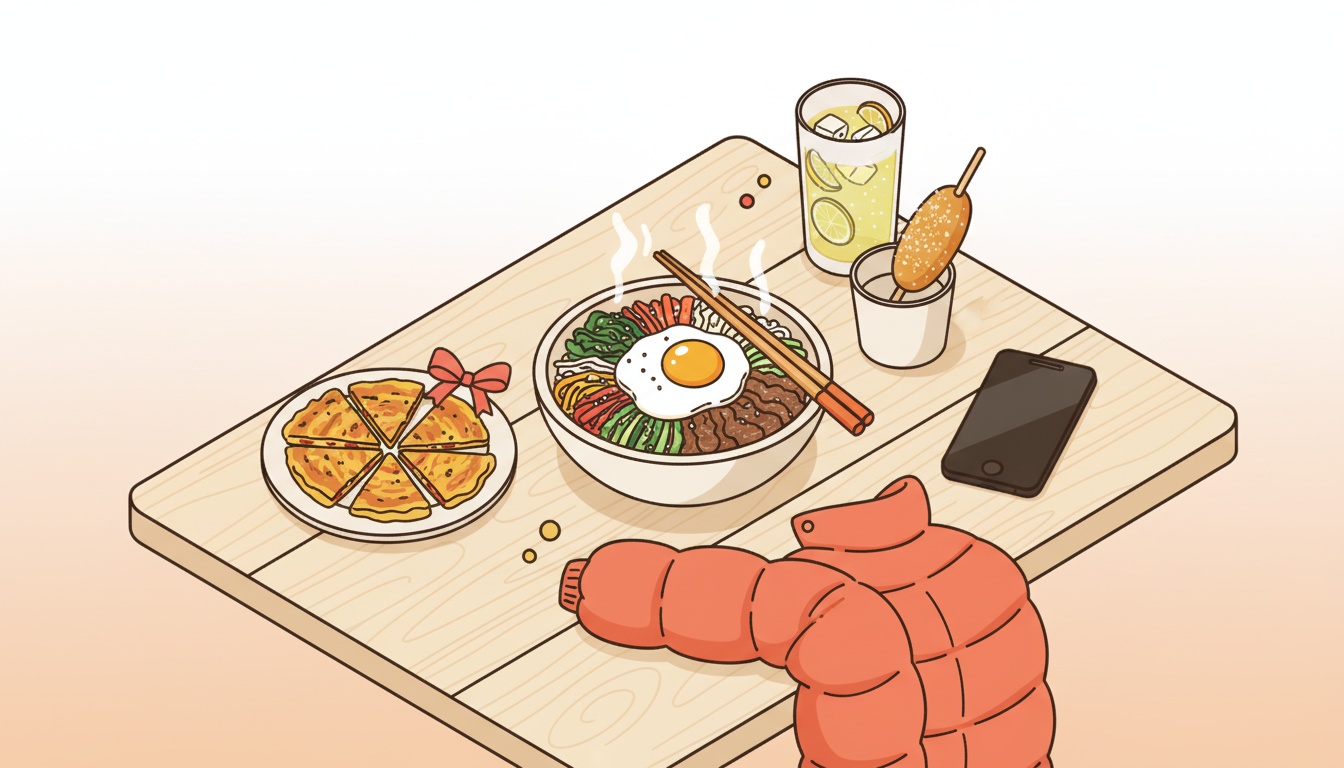
You order bibimbap and the server sets a small plate of kimchi pancake next to it, smiles, and says "서비스." You nod, assuming this is "customer service." It isn't. 서비스 in Korean means the free side dish the chef sent out on the house. Nothing to do with customer service.
That's Konglish — English-origin Korean vocabulary whose meanings have shifted, narrowed, or fused into words English speakers have never said. Most guides treat these as traps. They aren't. They're real Korean. If you insist on the "pure" equivalents (휴대전화 for cell phone, 탄산음료 for soda) in a casual chat, you'll sound like a translation app reading itself aloud.
What you actually need is a map of when each Konglish word shows up and what it means once it gets there. This guide walks through the ones that come up most, organized by scenario — coffee shop, phone store, clothes rack, dating, work, K-drama, and your apartment. Before that, a quick pattern section so you can predict meanings instead of memorizing them.
How Konglish meanings drift
Most Konglish words got reshaped by one of four moves. Once you see the patterns, new ones stop surprising you.
Clipping. The source word gets chopped short. 아파트 comes from "apartment," 셀카 from "self-camera," 에어컨 from "air conditioner," 알바 from 아르바이트 (which itself is from German Arbeit via Japanese — a detour Hanmadi Korean traces nicely).
Blending. Two words smash together into a compound that doesn't exist in English. 핸드폰 is "hand" plus "phone." 모닝콜 is "morning" plus "call." 오피스텔 is "office" plus the "tel" from "hotel." 치맥 is the English "chi(cken)" fused with the Sino-Korean 맥(주), "beer." You won't find any of these in a Webster's.
Narrowing. The Korean meaning is a specific slice of the English word. 원피스 means "dress," not any one-piece garment. 핸들 means "steering wheel," not any handle. 서비스 means "a free item," not the broader sense of customer service.
Extension. The meaning wanders sideways or grows a new one. 미팅 is a group blind date. 컨닝 is cheating on an exam. 사이다 is Sprite, but it's also the slang word for a cathartic moment in a drama. Wikipedia's Konglish article catalogues dozens more. Every example that follows below is a clipping, a blend, a narrowing, or an extension — usually you can spot which.
At the café
The cheapest way to embarrass yourself at a Korean convenience store is to ask for 사이다 expecting apple cider. Here's what you actually get, plus three other café words that mean something different than you think.
사이다 (sa-i-da) — Sprite or 7UP. Never apple cider. Order 사이다 한 병 주세요 and you'll get a lemon-lime soda. The word has a second life in slang: 오늘 드라마 진짜 사이다였어 means "today's drama was so satisfying" — the same refreshing-burst image applied to a scene where a villain finally gets owned.
서비스 (seo-bi-seu) — the free side dish or small gift the staff throws in. 이건 서비스예요 means "this one's on the house." Ubiquitous at Korean BBQ restaurants, bakeries, and corner shops.
핫도그 (hat-do-geu) — almost always a corn dog, the battered sausage on a stick, rather than the American bun version. International hotel menus sometimes still use 핫도그 for hot-dog-in-a-bun, but a street-market 핫도그 is the stick. If you specifically want the bun version, you're asking by brand name.
원샷 (won-shat) — the drinking-party cheer for "down it in one." At a work dinner or a group soju round, someone yells 원샷! and everyone's supposed to empty the glass. Casual, almost exclusively drinking-culture.
Buying a phone
Walk into an SK Telecom or KT shop and "notebook" on the shelf is not what an English speaker is picturing. Here are the four words you need to negotiate a phone, a laptop, and a repair without going in circles.
핸드폰 (haen-deu-pon) — "hand phone," the everyday word for cell phone. A native speaker will ask 핸드폰 번호 좀 알려 주세요, "can I get your phone number?" The formal-written version is 휴대전화, and 휴대폰 sits in the middle (the same register logic covered in our Korean speech levels guide). If you use 휴대전화 with a friend, you sound like a news anchor.
노트북 (no-teu-buk) — a laptop. A paper notebook is 공책 or just 노트. This is the Konglish word foreigners mis-map most. 카페에서 노트북으로 일해요 means "I work on my laptop at a café," not that you write longhand.
셀카 (sel-ka) — a selfie, clipped from "self-camera." 셀카 한 장 찍자 means "let's take a selfie." A selfie stick is a 셀카봉.
A/S (e-i-e-seu) — "after service." It's warranty and post-purchase repair service. The sign A/S 센터 above a kiosk at an electronics store means the repair counter, which is exactly what you want when your 핸드폰 starts acting up.
Clothes shopping
원피스 (won-pi-seu) — a dress. A one-piece garment, not the Straw Hat Pirates. 이 원피스 예쁘지 않아? means "isn't this dress pretty?"
맨투맨 (maen-tu-maen) — a crew-neck sweatshirt. No basketball connection at all. It comes from "man-to-man" (as in the athletic apparel), but in a Korean clothing store it just means a pullover top.
패딩 (pae-ding) — a puffer jacket. 롱패딩, a "long padding," is the knee-length down coat every Korean teenager wears through the winter. The word drifted from "padding" (the material) to "puffer coat" (the specific garment).
아이쇼핑 (a-i-syo-ping) — window shopping. "Eye shopping." 오늘은 아이쇼핑만 할 거야 means "today I'm just browsing, not buying."
Dating and nightlife
미팅 (mi-ting) — a group blind date, traditionally between a group of male college students and a group of female ones, often three-on-three. Not a business meeting. If your Korean friend says 이번 주말에 미팅 있어, they are not going to work. (In a business context, 미팅 does also mean "meeting" — the word does double duty, which is why context matters.)
소개팅 (so-gae-ting) — a one-on-one blind date arranged by a mutual friend. 소개 means "introduction," and the "ting" is clipped from 미팅. 친구가 소개팅 시켜 준대 means "a friend is setting me up."
썸 (sseom) — clipped from "something." The ambiguous "talking stage" before two people officially date. 썸 타다 means "to be in that phase." Slangy, universal among Koreans under forty.
스킨십 (seu-kin-sip) — "skin-ship." General physical affection: hand-holding, hugging, arms linked. Platonic or romantic, not sexual. 한국 커플들은 스킨십이 많아 means "Korean couples are very physically affectionate." (How To Study Korean traces the word through Japanese; it wasn't invented in Korea, but it's lived there for decades.)
더치페이 (deo-chi-pei) — "Dutch pay," to split the bill. 오늘은 더치페이 하자 — "let's split it today." Increasingly normal among younger Koreans, still slightly awkward around older relatives who expect the eldest to pay.
Office and school
아르바이트 / 알바 (a-reu-ba-i-teu / al-ba) — a part-time job. Entered Korean from German Arbeit through Japanese アルバイト during the colonial period. 알바 is the clipped, everyday form: 카페에서 알바해 means "I work part-time at a café." A part-timer is an 알바생.
컨닝 (keon-ning) — cheating on an exam, from English "cunning" by way of Japanese カンニング. 시험에서 컨닝하면 안 돼 — "don't cheat on the test."
사인 (sa-in) — a signature, and also an autograph. 여기에 사인해 주세요 can mean "please sign here" at a bank or "can I have your autograph?" at a fan meet. Context tells you which.
호치키스 (ho-chi-ki-seu) — a stapler. Named after E.H. Hotchkiss, the turn-of-the-last-century American stapler brand whose name traveled through Japan into Korean as the generic term. Like calling a vacuum a Hoover.
Try it in Conversa
Practice with AI characters who adapt to your level and give real-time feedback.
Try Conversa FreeK-drama and pop-culture slang
파이팅 / 화이팅 (pa-i-ting / hwa-i-ting) — "you got this," "go go." Not aggressive. A Korean friend texting 시험 파이팅! is wishing you luck on an exam. You'll hear it at the end of variety shows, before sports games, and as the sign-off on every encouraging text message in the country.
꿀잼 (kkul-jaem) — "honey-fun," extremely fun. 꿀 means honey and 잼 is a clipped form of 재미 ("fun"). 이 드라마 진짜 꿀잼이야 — "this drama is so good." The opposite, 노잼 ("no-fun"), is equally common.
치맥 (chi-maek) — fried chicken and beer, the national pairing. 치(킨) plus 맥(주). Koreans credit the drama My Love from the Star with making the combination famous worldwide. 오늘 치맥 콜? — "chimaek tonight, deal?"
하드캐리 (ha-deu-kae-ri) — "hard carry," borrowed from gaming. Someone who singlehandedly carries a team to victory. Now you'll hear it about an actor: 그 배우가 이 드라마를 하드캐리했어 — "that actor carried this whole drama."
At home
아파트 (a-pa-teu) — an apartment, but specifically the massive high-rise complex most urban Koreans live in. These are branded communities with their own numbered buildings, security, and commercial floors. Saying 우리 아파트는 15층이야 paints a very different picture from the Western "apartment."
오피스텔 (o-pi-seu-tel) — "office-tel," a mixed-use studio building, its own category of Korean real estate. You can legally live there and also register a business there.
원룸 (won-rum) — "one room," a studio apartment. 학교 근처 원룸 구했어 — "I got a studio near campus."
헬스 / 헬스장 (hel-seu / hel-seu-jang) — the gym. Koreans go to 헬스 to lift and run. A regular English speaker "goes to the gym." A Korean friend will text 헬스장 가자 — "let's hit the gym."
비닐 (bi-nil) — "vinyl," meaning any kind of plastic — bags, wrap, sheeting. A plastic shopping bag is a 비닐봉지. The cashier will ask 비닐봉지 필요하세요? — "do you need a plastic bag?"
The real rule
The only real mistake with Konglish is assuming the English meaning. Koreans aren't speaking broken English when they say 핸드폰 or 원피스 — they're speaking their own vocabulary, which happens to have English-shaped raw material. Using the "proper" Korean word where nobody else does doesn't make you sound careful. It makes you sound like you downloaded a phrasebook from 1995.
The fastest way to internalize this is the same thing that works for any vocabulary: hearing it used in real scenes, over and over, until the Korean meaning overwrites the English one you started with. Binge a drama, or practice out loud with an AI conversation partner who doesn't blink when you say 핸드폰 instead of 휴대전화. If you want the parallel for Romance languages, the Spanish false-cognates guide runs the same play. The words are already in your head. You just have to let them mean what Koreans mean by them.