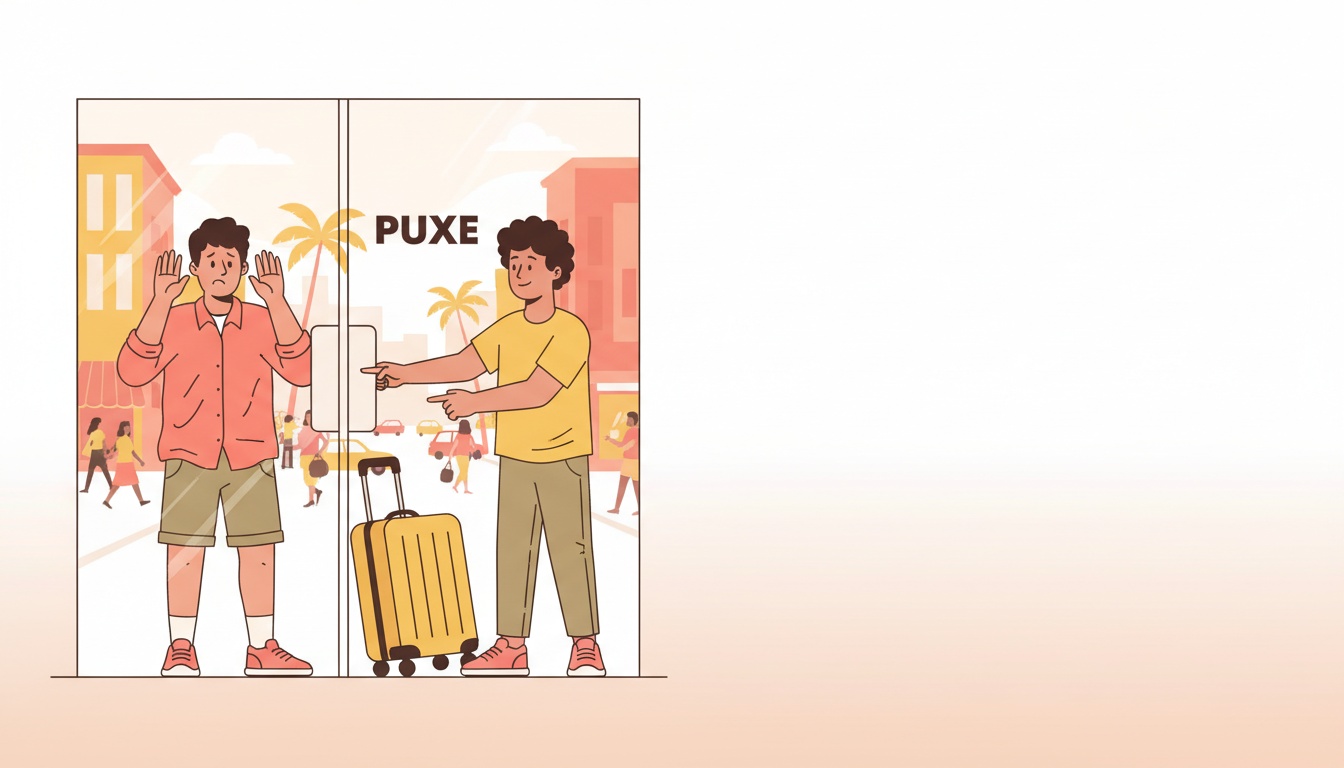
The first time I walked face-first into a glass door in São Paulo, the sign said PUXE. I was certain it meant "push." I pushed. The door did not move. I pushed harder. My forehead took the hit. A teenager behind me said "É pra puxar, tio" in the gentlest possible voice, which is how I learned that puxar means to pull, not push, and that Portuguese and English share enough Latin that most of the time, the English-sounding word is right. That's the trap. The 10% of the time it's wrong, you find out with your body, or with a pharmacist's eyebrows, or with a very confused coworker. It goes sideways in specific places: pharmacies, cafés, offices, train stations, dinner tables.
Here are the Portuguese words that ambush you grouped by where you'll actually meet them, with the line you reached for, the line you needed, and the fix. At the bottom there's a section just for Spanish speakers, because Portuguese has a whole second layer of traps for you.
At the pharmacy: the ones that send the wrong medical signal
— O que o senhor sente? — Estou constipado.
You meant "constipated." You just told the pharmacist you have a head cold. constipado in Portuguese means you're stuffed up, sniffling, asking for nasal spray. Constipated is com prisão de ventre, or in Brazil, com intestino preso. Saying "estou constipado" in a Lisbon farmácia is not embarrassing; it's just the wrong problem solved.
The pharmacy aisle has a few more that will get you:
- preservativo is not a preservative. It's a condom. Asking about the preservativos in the jam will earn you a very long pause. Food preservatives are conservantes. This is one of the most cited Portuguese false cognates because it's the one with the most social cost.
- ligar is not to tie. It means to call (on the phone) or to turn on. "Me liga mais tarde" is "call me later," not "tie me up later." To tie something is amarrar or atar.
- The pharmacy door itself, if it says puxe, means pull. If it says empurre, push. Lucy Bordin wrote an entire essay about how foreigners walk into Brazilian glass doors because their brain reads the first three letters and runs.
I still pause a beat before I say anything at a pharmacy counter in Portugal or Brazil. Constipado is one of those words whose wrongness I can feel in my chest a second before it leaves my mouth.
At the café: the ones that confuse the meal
— Vamos pegar um lanche?
You hear "lunch." You say yes. It's 4 p.m. and your Brazilian friend orders a ham-and-cheese toasted sandwich and a coffee. lanche is a snack, specifically the mid-afternoon kind: a sandwich, a pastry, something small between almoço (lunch, around noon) and jantar (dinner). A shop advertising lanche in the window is not serving lunch. It's serving snacks. Luciana Lage at Street Smart Brazil has an entire post on this because it trips up English speakers the minute they walk past their first lanchonete.
The café has other traps too:
- sobremesa is dessert. Not "something on the table." Spanish speakers have an extra problem here because in Spain sobremesa means the lingering post-meal conversation. In Portugal and Brazil, if the waiter asks "quer uma sobremesa?", they're asking if you want dessert.
- padaria is a bakery, not anything to do with Padua. In Brazil, a padaria is also the corner shop where you grab bread, coffee, a pão de queijo, and sometimes dinner. If a Brazilian tells you to meet them at the padaria, they're not inviting you to Italy.
- lanchonete (Brazil) and pastelaria or snack-bar (Portugal) are the same category of place, and neither is a lunch restaurant. If you want a sit-down meal, look for a restaurante or, in Portugal, a tasca.
The first time I asked a Brazilian friend where to get lanche near her office, I was expecting a real meal at 1 p.m. and got sent to a counter that only served sandwiches on white bread. I'd gotten the time wrong and the word wrong at the same time.
At the office: the ones that make you sound vague or slightly off
— O que você pretende fazer com esse relatório?
Your Brazilian manager hears: "what do you intend to do with this report?" You hear: "what are you planning to pretend to do with this report?" pretender means to intend, to plan, to aim to. Priberam lists the primary sense as tencionar, to have the intention. To pretend in the English sense is fingir. "Eu pretendo terminar amanhã" is "I intend to finish tomorrow," not "I'm going to pretend to finish tomorrow."
Office false cognates cluster hard. The ones you'll meet in your first week:
- realizar means to carry out, to execute, to accomplish. "Realizei o projeto" is "I completed the project," not "I realized the project existed." To realize in the "notice" sense is perceber or dar-se conta. In casual Brazilian speech you'll occasionally hear realizar used the English way, but in a work email, stick with perceber.
- data is a date on the calendar. The English "data" (information, statistics) is dados. If your boss asks for the data of the meeting, they want the day, not the spreadsheet.
- legenda is a caption or a subtitle. The legend of King Arthur is a lenda. Turning on legendas on Netflix turns on subtitles, which is actually one of the better habits you can build while learning.
- compromisso is a commitment or a scheduled appointment. "Tenho um compromisso às três" is "I have an appointment at three." The English "compromise" in the meet-in-the-middle sense is acordo or meio-termo.
- assistir and atender flip their English-sounding meanings. assistir means to watch a film or attend an event: "vou assistir o jogo" is "I'm going to watch the game." atender means to answer the phone or help a customer: "já estou atendendo" at a counter means "someone's already helping you." Neither does what its English twin does.
Rough rule: in a Portuguese office, any verb that looks exactly like an English verb deserves a five-second check before you commit to it. The tighter the resemblance, the bigger the trap.
On the move: the ones that reroute your trip
— Essa porta é puxe? — Não, é empurre.
You're tired, you're carrying a suitcase, and the glass door says PUXE. Your English brain reads "push." You shoulder the door. Nothing happens. Practice Portuguese lists this as one of the first traps English speakers hit, and the word you needed was empurre if you wanted to push. The door was telling you puxe, pull.
On the road, false cognates multiply because you're tired and reaching for whatever sounds familiar:
- recordar is to remember, not to record. "Recordo aquele dia" is "I remember that day." To record audio or video is gravar. Your phone doesn't recorda a video; it grava.
- livraria is a bookstore, not a library. The famous Livraria Lello in Porto is a bookstore, not a library. A library is biblioteca. If a Portuguese friend says they spent the afternoon at the livraria, they went shopping for books, not studying.
- êxito means success. The exit is saída. Pointing at an êxito sign and telling a friend "it's over there" is not directions.
- fábrica is a factory. Fabric is tecido. If a tour guide says "à direita há uma fábrica de tecidos," there's a textile factory over there, not a roll of cloth.
- If you're buying a train ticket: Brazilians say trem, Portuguese say comboio. Asking for a trem in Lisbon will earn you a patient explanation that the word is comboio and the ticket office is over there.
Traveler's cheat: before you walk into a new situation, think about what you're actually going to ask, then pre-check the one or two words you're about to reach for.
Meeting the family: the ones that derail small talk
— E os seus parentes, moram perto?
You answer about your mom and dad. Your Portuguese or Brazilian host was asking about your relatives, all of them. parentes covers aunts, cousins, in-laws, grandparents, the whole tree. Parents specifically are pais. The trap is that pai means father, so English speakers hear pais as something like "dads" and keep talking about their mother. Meanwhile the host is trying to figure out whether your extended family is in the same city.
Family small talk is where the character-describing words pile up, and most of them are fakes:
- sensível doesn't mean sensible. It means sensitive. Telling your partner's mother that her son is muito sensível says he cries at commercials. The word for "sensible" in the level-headed sense is sensato or razoável.
- polido doesn't mean polite. It means polished, literally, like a stone or a piece of wood. Polite is educado or cortês. Calling someone polido means they shine.
- pasta is a folder or a briefcase. The food is massa. A Brazilian colleague who grabs a pasta off the desk is taking a file, not a bowl of spaghetti.
- costume is a habit or a custom. "É costume jantar tarde" is "it's customary to eat dinner late." The Halloween kind of costume is fantasia in Brazil and fato in European Portuguese. And fato on its own in Portugal also means a suit, as in business suit, which is why a Portuguese shop window advertising fatos de banho is selling swimsuits.
Try it in Conversa
Practice with AI characters who adapt to your level and give real-time feedback.
Try Conversa FreeIf you already speak Spanish: the Portuguese traps nobody warns you about
Compliment a Portuguese host on dinner with "que esquisito!" and watch their face fall. In Spanish, exquisito is the word for exquisite, delicious. In Portuguese, esquisito means weird, strange, or off-putting. Same Latin root, opposite everyday meaning. The word you wanted was requintado, or just ótimo. This is one of an entire second layer of false cognates that hit Spanish speakers specifically, and most posts about Portuguese for English speakers skip them completely. If you're coming from Spanish, these are yours:
- embaraçada (PT) means embarrassed, awkward, or tangled up. embarazada (ES) means pregnant. Flipped from the Spanish-speaking scenario, where an English speaker accidentally announces a pregnancy. In Portuguese, "estou embaraçada" just means "I'm flustered." The Portuguese word for pregnant is grávida.
- oficina (PT) is a workshop or a mechanic's garage. oficina (ES) is an office. The Portuguese word for an office is escritório. If a Brazilian says they have to "passar na oficina", they're taking the car in, not going to work. Speaking Brazilian has a full breakdown of the crossover set.
- polvo (PT) is an octopus. polvo (ES) is dust. These are not the same word; they just landed on the same spelling. Wiktionary traces the Portuguese polvo back to Latin polypus (octopus) and the Spanish polvo back to Latin pulvis (dust). A Portuguese menu's arroz de polvo is octopus rice. If you order it expecting something fluffy with powder on top, you will be surprised.
- salsa (PT) is parsley. salsa (ES, in most contexts) is sauce. If you ask a waiter in Lisbon for "mais salsa, por favor" thinking of Mexican salsa, you're getting a sprinkle of chopped parsley. The sauce you wanted is molho.
- borracha (PT) is a rubber eraser. borracha (ES) is a drunk woman. Asking a São Paulo classmate "me empresta uma borracha?" is completely routine. Asking a Madrid classmate the same thing sounds like a very strange insult.
- pelado (PT, especially Brazil) means naked. pelado (ES) usually means bald or peeled. Telling a Brazilian friend you went to the beach "pelado" means you went nude. If you meant you shaved your head, use careca.
- apelido (PT, Brazil) is a nickname. apellido (ES) is a surname. If a Brazilian form asks for your apelido, they want "Bia" or "Tuca," not "Rodriguez." Quick warning: in European Portuguese, apelido can also mean surname, which makes the word a three-way false friend across Brazil, Portugal, and Spain. When in doubt, ask.
Portuguese looks so much like Spanish on the page that Spanish speakers routinely skip the vocabulary step and walk into all of these in the first week. The fact that the false cognates are fewer than the real cognates is exactly what makes them dangerous: your reflex says "same," and you find out otherwise at the fish counter.
How to train yourself out of Portuguese false cognates
I once stood in a Lisbon pharmacy at 9 p.m. with a mental list of thirty Portuguese false cognates in my head, and constipado still came out of my mouth when I had a stomach bug. The list sits in your head in a calm room. The actual word comes out of your mouth in a pharmacy at night. Memorizing a top-ten list doesn't work. What works is rehearsing the word inside the scene.
Three moves that actually help:
Build scenes, not flashcards. Instead of pretender = to intend, write yourself the full line you'd say: "Pretendo terminar isso até sexta." Practice the line, not the pair. This is the same principle behind scene-based listening practice: context trains recall better than isolated vocabulary pairs.
Treat exact-match cognates as suspect. Portuguese words that sound partially like English, such as interessante, importante, necessário, are almost always fine. The words that sound exactly like English are the traps: constipado, pretender, realizar, assistir, livraria. The tighter the match, the more likely it's a fake. If you're coming from Spanish, apply the same rule to Spanish-Portuguese pairs. Esquisito vs exquisito, polvo vs polvo, oficina vs oficina, same rule, different language.
Practice out loud where the stakes are zero. You can't rehearse these traps on a textbook page because they're context-dependent, and the context has to feel real. An AI conversation partner like Conversa lets you run the same scene (the pharmacy, the café counter, the office meeting) over and over until the correct Portuguese word is the one that shows up first. If you want early access, you can join the tester list. If you also speak Spanish, the Spanish version of this guide pairs with this one, with the same mechanics and a different set of ambush words.
The real lesson
The next time you walk into a padaria in Lisbon or a lanchonete in São Paulo, the only words that matter are lanche (it's a snack), puxe (pull the door), and constipado (you have a cold). Not the list of forty-odd false cognates you've been carrying around. Just those three, plus esquisito if you're Spanish-speaking and about to compliment someone's cooking. Portuguese false cognates are not a memory problem. They're a rehearsal problem. Pick the next city you'll be in, Rio or Lisbon or Porto or São Paulo. Pick the three scenes you'll actually be in there. Load the three swaps for those three scenes. That's the whole job.